

Posts tonen met het label duurzame ontwikkeling. Alle posts tonen
Posts tonen met het label duurzame ontwikkeling. Alle posts tonen
woensdag 3 maart 2021

Open SDG Data Hub

woensdag 24 februari 2021
The environmental justice atlas

maandag 15 februari 2021
Evaluating Environment in International Development

"This book provides novel and in-depth perspectives on evaluating environment and sustainability issues in developing countries. Evaluating Environment in International Development focuses on the approaches and experiences of leading international organizations, not-for-profits, and multilateral and bilateral aid agencies to illustrate how systematic evaluation is an essential tool for providing evidence for decision-makers. Moving beyond projects and programmes, it explores normative work on the environment as well as environmental consequences of economic and social development efforts. This new edition reflects on the 2030 Agenda for Sustainable Development and Sustainable Development Goals and considers how they have influenced efforts in a wide range of countries and what the implications are for evaluation. It also explores ways in which Big Data and geospatial approaches might be utilised. Significantly updated throughout to reflect recent developments in climate change research, and on the implications of the 2020 pandemic, this volume will be of great interest to students and scholars of environment studies, development studies, international relations, sustainable development and evaluation, as well as practitioners in international organizations and development and environmental NGOs."
vrijdag 22 januari 2021

donderdag 7 januari 2021
Time to reach for the moon the EU needs to step up action and lead the transformation to sustainability

Time to reach for the moon the EU needs to step up action and lead the transformation to sustainability - Civil society SDG monitoring report / Sylvia Beales & George Gelber. SDGwatch, 2020.
"This report explains why the EU's SDG reporting creates an illusion of sustainability and makes concrete proposals for meaningful monitoring to become a stronger foundation for transformative policies. We tell a more critical story about sustainability in the EU. Our report flags up serious gaps, bringing them to life with 17 individual stories.We also share our vision of what a truly sustainable Europe could look like. We show what we can achieve by 2030 if we do the right things now, building on our Manifesto for a Sustainable Europe for its Citizens, published by civil society for the 2019 European Elections. We offer 17 solutions, real-life examples of progressive policies, innovative initiatives and truly sustainable business models. These glimpses of a sustainable Europe nurture hope and inspire action in people – and need a progressive political framework to support and scale them up."
maandag 12 oktober 2020
Klimaatbeleid en de samenleving

maandag 31 augustus 2020
The myth of global sustainability : Environmental limits and (de)growth in the time of SDGs
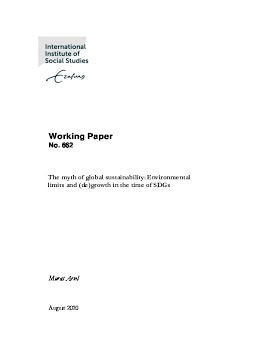
"The elevation of sustainability from being one of the more peripheral goals in the MDGs to titular status in the SDGs could be interpreted as a sign that the international development sector has finally recognized the gravity of the ecological challenge facing humanity. Similarly, the geographic and conceptual shift from the MDGs’ focus on the developing world to SDGs’ global framing could be read as an acknowledgement that sustainability is not a problem that needs to be tackled ‘out there’ but systemic in nature. Nevertheless, the paper argues that the SDGs are unlikely to bring about the necessary transformations as long as the primacy of economic growth is not challenged. This cannot be achieved by simply recognizing the validity of environmental limits and adapting a degrowth position. It is also necessary to recognize that transformation to sustainability is inherently a conflictual process."
dinsdag 2 juni 2020
Transforming International Cooperation: thoughts and Perspectives on Moving Beyond Aid

Transforming International Cooperation: thoughts and Perspectives on Moving Beyond Aid / Juliane Kolsdorf, Ulrich Müller (Ed.). Nomos, 2020.
"The world of international cooperation is in transition. Global power shifts and the rise of populism have made the world multipolar, but not necessarily more multilateral. The traditional North–South aid system is being called into question, while transnational challenges are affecting all countries and require stronger global partnerships. In this context, the graduation of countries from Official Development Assistance (ODA) stands out as a focal topic in connecting current debates.Facilitated by the Deutsche Gesellschaft für Internationale Zusammenarbeit (GIZ), this publication sees experts from various sectors and regions share and exchange their views in open dialogues and spotlight texts. They embed ODA graduation in its broader global context, discuss its implications and call for a new partnership based on global goals and knowledge sharing. This collection of thoughts and perspectives will thus hopefully serve as a milestone in the debate on transforming international cooperation."
woensdag 27 mei 2020
Families, Family Policy and the Sustainable Development Goals

Families, Family Policy and the Sustainable Development Goals / Dominic Richardson, Esuna Dugarova, Daryl Higgins, Keiko Hirao, Despina Karamperidou, Zitha Mokomane & Mihaela Robila . Unesco, 2020.
"This report explores how the role of families, and family policies from around the world, can contribute to meeting the ambitions of the Sustainable Development Goals (SDGs). Given the key role that both families and family policies have in determining social progress, and the national and international focus on meeting the SDGs by 2030, the timing of the publication is opportune. The report summarizes reviews of evidence across six SDGs that cover poverty, health, education, gender equality, youth unemployment, and ending violence to highlight some important issues that policymakers might consider when making future policies work for families, and family policies work for the future. A key contribution of the work, given the broad scope of the SDG ambitions, has been to map how the successes of family-focused policies and programmes in one SDG have also been successful in contributing to positive outcomes in other goal areas."
dinsdag 28 april 2020
Earth 2020: an Insider’s Guide to a Rapidly Changing Planet

Earth 2020: an Insider’s Guide to a Rapidly Changing Planet / Philippe Tortell (ed.). Open Book Publishers, 2020.
"Fifty years have passed since the first Earth Day, on 22 April 1970. This accessible, incisive and timely collection of essays brings together a diverse set of expert voices to examine how the Earth’s environment has changed over this past half century, and what lies in store for our planet over the coming fifty years.
Earth 2020: An Insider’s Guide to a Rapidly Changing Planet responds to a public increasingly concerned about the deterioration of Earth’s natural systems, offering readers a wealth of perspectives on our shared ecological past, and on the future trajectory of planet Earth.
Written by world-leading thinkers on the front-lines of global change research and policy, this multi-disciplinary collection maintains a dual focus: some essays investigate specific facets of the physical Earth system, while others explore the social, legal and political dimensions shaping the human environmental footprint. In doing so, the essays collectively highlight the urgent need for collaboration across diverse domains of expertise in addressing one of the most significant challenges facing us today.
Earth 2020 is essential reading for everyone seeking a deeper understanding of the past, present and future of our planet, and the role of humanity in shaping this trajectory."
donderdag 9 april 2020

maandag 6 april 2020
' Nachhaltigkeit'-themanummer. In: weiter bilden 1/2020

Rohwerder, Jan; Bremer, Leonie; Kopatz, Michael; Lorenzen, Klaus-Peter
»Nicht nur die Jugend braucht Radikalität!«
weiter bilden spricht mit Leonie Bremer, Michael Kopatz und Hans-Peter Lorenzen
Was müssen wir noch über den Klimawandel lernen? Oder wissen wir schon längst genug? Was fehlt, um nachhaltig zu leben und den Klimawandel effektiv zu bekämpfen? Welche Rolle kann Bildung spielen? Über diese Fragen sprach Redakteur Jan Rohwerder mit Leonie Bremer, Pressesprecherin von »Fridays for Future« Köln, Dr. Michael Kopatz, Sozialwissenschaftler und Projektleiter Energie-, Verkehrs- und Klimapolitik am Wuppertal Institut für Klima, Umwelt, Energie, und Hans-Peter Lorenzen, Geschäftsführer der Volkshochschule Braunschweig.
17
Schreiber-Barsch, Silke
Erwachsenenbildung als Nachhaltigkeit
Das Ringen um den Erhalt der Lebensgrundlagen als Lern- und Bildungsprozess
In ihrem Beitrag reflektiert die Autorin nicht nur die begrifflichen Grundlagen und die Verflochtenheit der Nachhaltigkeitsdebatte. Indem sie argumentiert, Erwachsenenbildung müsse als Nachhaltigkeit verstanden werden, schärft sie das erwachsenenpädagogische Profil des Nachhaltigkeitsbegriffs und stellt gleichzeitig dessen normative Grundlagen zur Debatte.
21
Dieckmann, Annette; Loewenfeld, Marion
Zwischen inhaltlicher Ausweitung und struktureller Verankerung
Klima und Nachhaltigkeit als Themen in non-formalen Umweltbildungseinrichtungen
Die in der Arbeitsgemeinschaft Natur- und Umweltbildung e. V. (ANU) versammelten Einrichtungen und Akteure bieten Bildung für nachhaltige Entwicklung (BNE) und Umweltbildung unterschiedlichster Formen an. Wie BNE in Einrichtungen wie Kommunen strukturell verankert werden kann, zeigen die Autorinnen anhand von systematischen Überlegungen und Praxisbeispielen.
26
Spaude, Magdalena
Kostenlose Bildungsmaterialien zum Klimawandel
Weshalb offene Lizenzen wichtig sind
Heutzutage ist es einfach, zu vielen Themen kostenlose Bildungsmaterialien zu erhalten. Doch wie kann die Qualität der Materialien eingeschätzt werden, welche Fallstricke gilt es bei der Verwendung zu beachten? Am Beispiel von Bildungsmaterialien zum Klimawandel zeigt die Autorin, dass es Unterstützung für die Einschätzung gibt und dass es hilfreich ist, auf die Lizenzierung zu achten.
32
Brocchi, Davide
Nachhaltig unsozial
Die soziale Blindheit der Nachhaltigkeitsdebatte
Wie reagiert die Menschheit auf die Klimakrise? Die Wende zu einer nachhaltigen Lebensweise und Gesellschaftsform wäre eine sinnvolle Reaktion, doch Strukturen der sozialen Ungleichheit behindern diesen Wandel. Wie kann Bildung dazu beitragen, diese Strukturen zu verändern und damit einer Lösung der Klimakrise näher zu kommen?
35
Boden, Günter
Nachhaltig zertifiziert
BNE-Zertifizierung als Qualitätsentwicklungs- und Professionalisierungsinstrument
In den vergangenen Jahren sind unterschiedliche BNE-Zertifizierungen entwickelt worden. Aus den Erfahrungen eines Projekts zur Entwicklung einer solchen Zertifizierung zeigt der Autor, wie ein Zertifizierungsprozess Einrichtungen helfen kann, sich im Bereich BNE zu professionalisieren.
donderdag 6 februari 2020
Open access e-book: Anthropocene Unseen : a lexicon / Cymene Howe & Anand Pandian

Anthropocene Unseen: a lexicon / Cymene Howe & Anand Pandian. Punctum Books, 2020.
"The idea of the Anthropocene often generates an overwhelming sense of abjection or apathy. It occupies the imagination as a set of circumstances that counterpose individual human actors against ungraspable scales and impossible odds. There is much at stake in how we understand the implications of this planetary imagination, and how to plot paths from this present to other less troubling futures. With Anthropocene Unseen: A Lexicon, the editors aim at a resource helpful for this task: a catalog of ways to pluralize and radicalize our picture of the Anthropocene, to make it speak more effectively to a wider range of contemporary human societies and circumstances. Organized as a lexicon for troubled times, each entry in this book recognizes the gravity of the global forecasts that invest the present with its widespread air of crisis, urgency, and apocalyptic possibility. Each also finds value in smaller scales of analysis, capturing the magnitude of an epoch in the unique resonances afforded by a single word.he Holocene may have been the age in which we learned our letters, but we are faced now with circumstances that demand more experimental plasticity. Alternative ways of perceiving a moment can bring a halt to habitual action, opening a space for slantwise movements through the shock of the unexpected. Each small essay in this lexicon is meant to do just this, drawing from anthropology, literary studies, artistic practice, and other humanistic endeavors to open up the range of possible action by contributing some other concrete way of seeing the present. Each entry proposes a different way of conceiving this Earth from some grounded place, always in a manner that aims to provoke a different imagination of the Anthropocene as a whole. The Anthropocene is a world-engulfing concept, drawing every thing and being imaginable into its purview, both in terms of geographic scale and temporal duration. Pronouncing an epoch in our own name may seem the ultimate act of apex species self-aggrandizement, a picture of the world as dominated by ourselves. Can we learn new ways of being in the face of this challenge, approaching the transmogrification of the ecosphere in a spirit of experimentation rather than catastrophic risk and existential dismay? This lexicon is meant as a site to imagine and explore what human beings can do differently with this time, and with its sense of peril."
woensdag 20 november 2019
maandag 26 augustus 2019
Unesco Courier 2019/3 - special issue: Climate change: the ethical challenges

The UNESCO Courier | July - September 2019
"With this special report, the Courier aims to open up new avenues for reflection on these lesser-known aspects of the greatest global challenge of our times. Because, in parallel to the scientific issues that hit the media headlines, the issues of justice and equity, respect for human rights, solidarity and scientific and political integrity, and individual and collective responsibility, must be the principal cornerstones of our actions on a global scale"
WIDE ANGLE: Climate change: The ethical challenges
-The philosophical and ethical issues of climate change / Bernard Feltz
-Climate crimes must be brought to justice / Catriona McKinnon
-Climate change: A new subject for the law / Anne-Sophie Novel
-Climate and social justice / Thiagarajan Jayaraman, interviewed by Shiraz Sidhva
-Pakistan: Green again / Zofeen T. Ebrahim
-Solar energy: Changing rural lives in Kenya / Victor Bwire
-Zero carbon, starting with cities! / Manuel Guzmán Hennessey
-African cities in action / Niels Boel and Finn Rasmussen, with Hadra Ahmed
-A question of international solidarity / Johan Hattingh
-Climate change and education / Laura Ortiz-Hernández
-Colonel: We must act quickly! / Thierry Geoffrey, interviewed by Niels Boel, Danish journalist
-Arshak Makichyan: The lone picketer / Interview by Jasmina Šopova
ZOOM: Arab youth, architects of their future / Katerina Markelova
IDEAS
-A tale of two futures / Sandrine Cathelat and Mathilde Hervieu
-AI innovations to counter social challenges / Interviews by Shiraz Sidhva
OUR GUEST: Baku: Multicultural city / Fuad Akhundov, interviewed by Mila Ibrahimova
Trending
-Dmitry Mendeleev: The teachings of a prophet / Natalia Tarasova and Dmitry Mustafin
-Mandela’s South Africa: Reality or distant dream? / Jody Kollapen, interviewed by Edwin Naidu, South African journalist
-Youth Forum in China / Interview by Chen Xiaorong
donderdag 14 maart 2019
SSH General College: “Europa, klaar voor een sociaal rechtvaardige klimaattransitie” - 3 april

Praktisch
woensdag 3 april 2019 om 10.30 in lokaal B101
Gratis inkom
UC Leuven Limburg. Campus Sociale School Heverlee. Groeneweg 151, Heverlee (lokaal B101)
Graag inschrijven
maandag 14 januari 2019
Unequal exposure and unequal impacts: social vulnerability to air pollution, noise and extreme temperatures in Europe

Unequal exposure and unequal impacts: social vulnerability to air pollution, noise and extreme temperatures in Europe / European Environment Agency, 2018.
"Europe's environmental quality has been steadily improving over recent decades. Nonetheless, air pollution and noise continue to contribute to serious illnesses and premature deaths, especially in urban areas. In addition, recent years in Europe have been marked by extreme temperatures with severe implications for human health. Exposure to air pollution, noise and extreme temperatures does not affect everyone in the same way. On the contrary, the uneven distribution of the impacts of air pollution, noise and extreme temperatures on the health of Europeans closely reflects the socio-demographic differences within our society. Personal characteristics, such as age or health, determine how sensitive people are to these environmental health hazards, i.e. how badly their health may be affected if they are exposed to them. In addition, people's ability to avoid, or cope with, these environmental health hazards is influenced by their socio-economic status (i.e. income, employment status or level of education). Older people, children, those experiencing material disadvantage and those in bad health are typically more vulnerable to air pollution, noise and extreme temperatures than the general population. They are also the ones who tend to have the least say in how and where they live, work or go to school, which, in turn, affects their exposure to these environmental health hazards. As a result, their health tends to suffer the most from the impacts of air pollution, noise and extreme temperatures."
vrijdag 28 september 2018
maandag 24 september 2018
Lezingenreeks “tijdelijk gebruik in stadsplanning” - Brussel

"De reeks “tijdelijk gebruik in stadsplanning” bekijkt thematisch hoe tijdelijk gebruik kan inspelen op stedelijke noden. Elke vrijdag behandelen Brussels Academy, Toestand en BRAL een ander thema (economie, wonen, cultuur, groene ruimtes, …) en bezoeken ze een andere plek (een voorbeeld van gebruik van een gebouw of ruimte) waar de presentatie en het debat ook zullen doorgaan":
28/09 WONEN / LOGEMENT (FR/NL) Nicolas Bernard (FUSL-B) ASBL Woningen 123 Logements
05/10 PROJET DE VILLE / STADSONTWERP (FR/NL) Aurelie De Smet (KUL) Anciennes casernes d’Ixelles / Oude kazernes van Elsene (Usquare)
12/10 KUNST EN CREATIVITEIT/ ART ET CREATIVITE (FR/NL) Tatiana Debroux (ULB) Studio CityGate
19/10 EMPLOI / TEWERKSTELLING (FR/NL) Roeland Dudal (Architecture Workroom) La Serre
26/10 GROENE RUIMTES / ESPACES VERTS (FR/NL)Chloé Deligne (ULB) (tbc) Gare de l’Ouest/ Weststation
9/11 SLOTDEBAT / DEBAT DE CLÔTURE tbc Allée du Kaai
GRATIS, OP INSCHRIJVING
Meer info vind je hier.
Abonneren op:
Posts (Atom)